
Wisdom Teeth
Wisdom teeth begin to grow in as you transition from your teens into early adulthood, but unfortunately, our modern jaws don’t always have enough space for them. When they can’t come in properly, these teeth can become impacted (trapped in the jawbone), grow in crooked, or push against your other teeth. This can lead to pain, infection, and other dental problems.
What’s the Big Deal About Wisdom Teeth?
For some, wisdom teeth can come in without a problem. But for many, they can lead to a host of issues that make removal the best course of action. Because of their location at the very back of the mouth, wisdom teeth are often difficult to clean. Even if they come in perfectly straight, their hard-to-reach position can lead to plaque buildup, decay, and damage to the neighboring teeth, putting your overall oral health at risk.
When to Consider an Evaluation
The American Association of Oral and Maxillofacial Surgeons recommends that wisdom teeth be evaluated by the time a person is a young adult. The ideal age for removal is typically between the ages of 14 and 21. During this time, the roots are not fully developed and the surrounding bone is less dense, which often leads to a smoother surgery and a faster recovery.
Even if you aren’t experiencing any pain, it’s a good idea to have your wisdom teeth evaluated. Many problems caused by wisdom teeth are asymptomatic—meaning they don’t cause pain or symptoms until they’ve already led to damage. A proactive approach can help you prevent issues like:
- Damage to neighboring teeth: An impacted wisdom tooth can put pressure on the second molar, leading to crowding or even decay in the tooth next to it.
- Pericoronitis: This is a localized gum infection that can occur when a wisdom tooth only partially erupts, creating a flap of gum tissue that traps bacteria.
- Cyst formation: In rare cases, a fluid-filled sac called a cyst can form around an impacted tooth, potentially damaging the jawbone and surrounding teeth.
What to Expect at a Wisdom Teeth Consultation
Your consultation is your opportunity to get a clear picture of your unique situation and ask any questions you may have. During your visit, your oral surgeon will:
- Review X-rays: A specialized X-ray will be taken to evaluate the position of your wisdom teeth, assess the space available for them, and determine if they are impacted.
- Conduct an Exam: Your oral surgeon will perform a thorough examination to assess the health of your mouth and identify any potential issues.
- Discuss Your Options: Based on the exam and X-rays, your surgeon will discuss whether removal is recommended and why. You’ll also learn about the different types of anesthesia available to ensure you are comfortable during the procedure.
- Answer Your Questions: We encourage you to ask questions about the procedure, recovery, and cost. Our team is here to help you feel confident and informed.
Why Choose Oral & Facial Surgery of Pittsburgh for Your Wisdom Teeth Surgery?
Choosing the right oral surgeon is a crucial decision, and at Oral & Facial Surgery of Pittsburgh, we are committed to providing the highest standard of care. Here’s what sets our practice apart:
- Board-Certified Oral and Maxillofacial Surgeons: All of our surgeons—Dr. Bauer, Dr. Norbutt, and Dr. Humberger—are board-certified in Oral and Maxillofacial Surgery. This is a distinction that demonstrates their commitment to the highest level of expertise and ongoing excellence in the field.
- Top-Tier Training and Academic Excellence: All three doctors completed their residency at the prestigious University of Pittsburgh Medical Center (UPMC). With extensive experience as faculty and program directors at the University of Pittsburgh’s Department of Oral and Maxillofacial Surgery, our surgeons are committed to state-of-the-art care, utilizing the most up-to-date technology and research.
- A Focus on Research and Advanced Techniques: Our surgeons are not just practitioners; they are leaders in the field. Dr. Bauer, for example, is a consultant for medical device companies and has lectured internationally, while Dr. Norbutt has published his research on bone regeneration. Dr. Humberger is even part of the Pittsburgh Penguins facial trauma team. This dedication to advanced techniques and ongoing research ensures you receive the most modern and effective treatment available.
- Shared Philosophy of Patient-Centered Care: Our entire team operates under the same philosophy: you, the patient, are an integral part of your treatment. From your initial consultation to your recovery, we work with you to ensure you are well-informed and comfortable every step of the way.
- Specialized in Your Procedure: While our surgeons have broad expertise, their scope of practice is focused on procedures like dental implants, bone grafting, and, most importantly, wisdom teeth removal. This specialization means they perform these procedures with a level of skill and efficiency that comes from years of dedicated experience.
Book An Appointment
Whether you need a full evaluation or just want to discuss your options, we are here to provide the highest level of care. We invite you to schedule an appointment online or over the phone.
FAQs
Have questions? We have answers. Below are some of the most common questions our patients have about wisdom teeth.
- Do I have to get my wisdom teeth removed even if they aren’t causing problems?
Not everyone needs their wisdom teeth removed, but an evaluation is highly recommended. Many wisdom teeth issues, such as damage to adjacent teeth or the formation of cysts, can be asymptomatic, meaning they don’t cause pain or symptoms until the problem advances. By proactively scheduling an X-ray, we can identify potential problems before they lead to pain or more complex complications. For many people, early removal is a preventative measure that saves them from more difficult and painful issues later. - What happens if I choose not to have my wisdom teeth removed?
The decision not to remove your wisdom teeth is a personal one, but it is important to be aware of the potential risks. If left untreated, impacted or problematic wisdom teeth can lead to localized issues such as cyst formation, gum disease, and bone loss. Additionally, it is common for the wisdom teeth to cause crowding or damage to the adjacent teeth over time. As you get older, the roots of your wisdom teeth become longer and the jawbone becomes more dense, which can make a future removal procedure more complicated and result in a longer recovery period. A consultation with our oral surgeons is the best way to determine if your wisdom teeth pose a risk and to discuss the right choice for your oral health. - How do I know if my wisdom teeth are coming in?
The most common signs of wisdom teeth eruption are a persistent ache, swelling, or tenderness in the back of your jaw. You might also notice a pressure sensation or see a small flap of gum tissue (called a pericoronal flap) where the tooth is trying to break through. Because these symptoms can also be a sign of infection or impaction, it’s important to have an oral surgeon examine them to determine the cause. - Is jaw pain a sign of a wisdom teeth problem?
Yes, jaw pain is a very common sign of a wisdom teeth problem. When wisdom teeth don’t have enough room to come in properly, they can put pressure on the jawbone, adjacent teeth, and nerves. This can cause a dull, persistent ache in your jaw, which can be mistaken for other issues. If you’re experiencing this kind of pain, it is a strong indicator that you should schedule a consultation to have your wisdom teeth assessed. - What is the best age for wisdom tooth removal?
The ideal age for wisdom tooth removal is typically in the mid-to-late teenage years, between the ages of 14 and 21. During this time, the roots of the wisdom teeth are not yet fully formed and the jawbone is less dense, which generally makes the surgical procedure less complicated and the recovery faster and more predictable. While wisdom teeth can be removed at any age, the risk of complications and extended recovery period increases as the bone matures with age. - Do all four wisdom teeth need to be removed?
Not always. While it’s very common for people to have all four wisdom teeth removed in one procedure, this is not a one-size-fits-all approach. Some patients may only have one or two wisdom teeth that are causing problems, or they may not have all four to begin with. Your oral surgeon will perform a thorough evaluation and take X-rays to create a personalized treatment plan for you. - Will my wisdom teeth grow back after they are removed?
No, wisdom teeth do not grow back once they have been surgically removed. The surgical procedure extracts the entire tooth, including its root, so there is no possibility of it re-growing. However, it’s possible for some people to have more than four wisdom teeth (a condition called hyperdontia), which may be visible on X-rays before the procedure. - How long does a wisdom teeth removal procedure take?
The duration of the procedure varies depending on the number of teeth being removed and their position and level of impaction. An uncomplicated extraction of all four wisdom teeth can often be completed in as little as 30 to 60 minutes. Your total time in the office, including preparation and recovery, is usually around 90 minutes. - Do I need to be put to sleep for the procedure?
Your comfort is our top priority. We offer a variety of anesthesia options, ranging from local anesthesia (numbing the area) to various levels of sedation. We will discuss the most suitable option for your specific case during your consultation, ensuring you feel comfortable and at ease throughout the entire process.
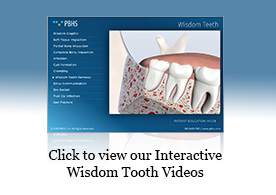
Wisdom Teeth Presentation
To provide you with a better understanding of wisdom teeth, we have provided the following multimedia presentation. Many common questions pertaining to wisdom teeth are discussed.